Trade

Sunday, December 14, 2025

France opposes EU–Mercosur deal, calls for delays and stronger safeguards

Article cover

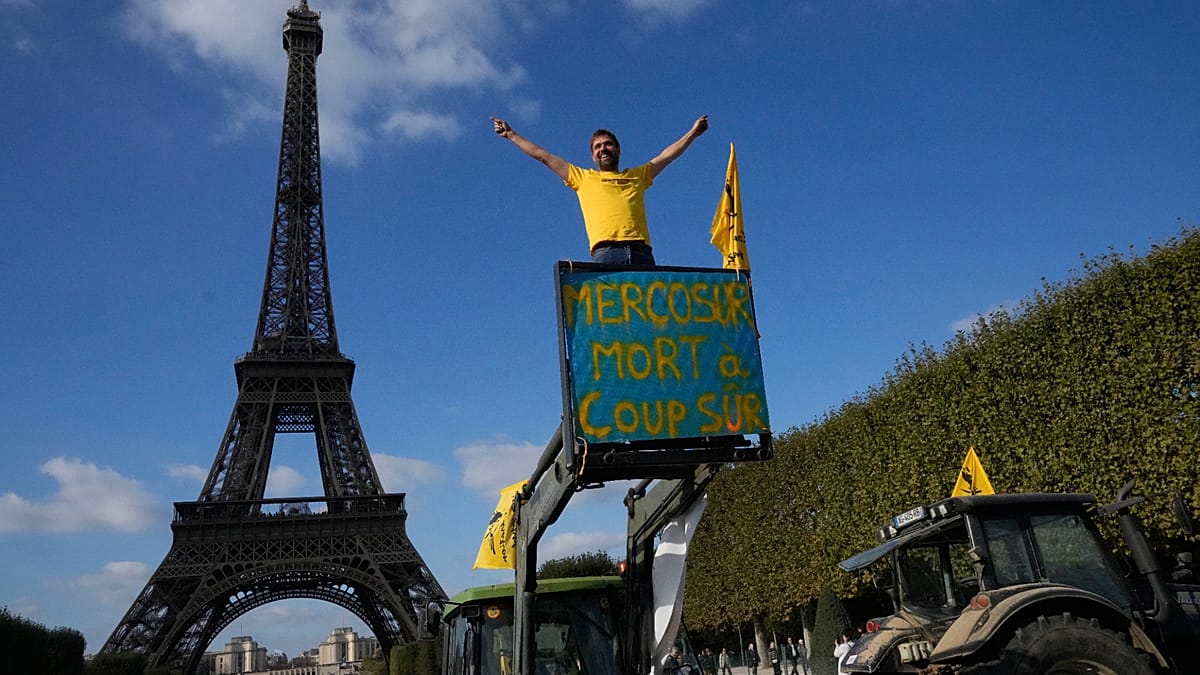
France has rejected the EU–Mercosur trade agreement in its current form and has pushed to delay signing and votes, demanding stronger safeguards for French farmers, mirror/reciprocity clauses on production and tighter import controls. Paris has urged more robust safeguard mechanisms and alignment of environmental and sanitary standards before authorising the pact.

Key facts

France says EU-Mercosur deal is not acceptable in its current form

France demands stronger safeguard clauses, equal standards and import controls

France has asked to delay EU Council vote/signing deadlines on the deal

The EU-Mercosur deal is between the EU and Argentina, Brazil, Paraguay, Uruguay

French National Assembly voted 245-0 to reject the EU-Mercosur FTA in a non-binding vote

Perspectives

🇫🇷

French govt & farmers

Rejecting the EU–Mercosur deal in its current form is necessary and justified. As it stands, it exposes our farmers to unfair competition and undermines our environmental and health standards; delaying it allows us to defend our agricultural model and demand genuine reciprocity.

Best arguments

No free trade without fair trade and strict reciprocity. Mercosur producers often operate under looser environmental, animal welfare and sanitary rules, lowering their costs. Letting such products enter freely would undercut EU farmers bound by stricter regulations. Mirror clauses are essential to ensure imports meet the same rules as our own production.

French and European rural communities must not be sacrificed. Our farms sustain jobs, local services and territorial cohesion. A flood of cheaper imports, produced under weaker standards, could bankrupt many family farms. Defending safeguard clauses and tight import controls is about protecting livelihoods and keeping our countryside alive.

Climate and health goals cannot be traded away for volumes. The draft agreement risks boosting deforestation-linked exports and products with lower sanitary guarantees. This contradicts the EU Green Deal and citizen expectations on food safety and sustainability. Strong, enforceable environmental and health conditions are non‑negotiable preconditions.

🇪🇺

European Commission & pro‑deal EU

France’s move creates yet another political delay in a file that is already decades old and risks weakening the EU’s credibility as a serious trade partner. Legitimate farmer and standards concerns should be handled with targeted safeguards, not by indefinitely stalling or reopening the agreement.

Best arguments

Stalling now undermines EU credibility and geopolitical weight. After 20+ years of negotiations, another blockage signals to partners that the EU cannot deliver on major deals. This weakens our influence in Latin America, opens the door to competitors like China, and contradicts our ambition to be a global rule‑shaper, not a bystander.

The agreement already embeds high environmental and standards commitments. The text contains binding sustainability, Paris Agreement and sanitary rules that go beyond what Mercosur has with others. Demanding constant new clauses risks making any future EU deal impossible, instead of using existing mechanisms and side‑instruments to address remaining concerns.

Farmers’ concerns can be managed with precise safeguards, not a veto. Tariff‑rate quotas, safeguard measures and monitoring can protect sensitive sectors while still unlocking export gains for EU industry and services. We should refine implementation tools, compensation and adjustment support, rather than sacrificing strategic trade for domestic short‑term politics.

🌎

Mercosur countries

France’s rejection of the agreement in its current form is a setback to a deal that took over two decades to negotiate and balance. The new demands risk turning a trade pact into a moving target, undermining legal certainty, limiting our export gains, and weaponising standards as disguised protectionism against Mercosur.

Best arguments

Paris is shifting the goalposts after 20+ years of negotiation. We concluded a political agreement after painstaking talks where both sides made concessions. Introducing fresh conditions now—after texts are balanced—erodes trust, legal certainty, and the credibility of the EU as a negotiating partner, discouraging investment and long‑term planning in our region.

Mirror clauses risk becoming protectionism dressed as ‘fair competition’. So‑called reciprocity on production ignores structural differences in climate, costs, and development levels. If EU rules are mechanically “mirrored” onto our producers, they function as de facto trade barriers, wiping out much of the market access we were promised and narrowing our development space.

Using environmental and sanitary rules as trade filters is unfair and counterproductive. We are committed to sustainability and high sanitary standards, but these must be addressed through cooperation, not unilateral filters that privilege EU producers. Turning green and SPS standards into extra trade locks punishes competitive exporters in Mercosur and weakens the strategic EU–Latin America partnership.

Common Distortions

Framing tactical delay or renegotiation demands as near-total rejection of an agreement: Portraying calls to postpone deadlines or adjust safeguard clauses as outright rejection can blur the distinction between renegotiation and definitive opposition, exaggerating the fragility or finality of complex trade talks.

Using highly emotive metaphors that amplify perceived threat beyond factual stakes: Quoting or foregrounding dramatic phrases like “weapon of mass destruction” for policy disputes can skew readers’ risk perception, making standard economic competition appear akin to catastrophic or existential danger.

Does anything look off?

Unbubble News

Automated fact checks, context, and multiple viewpoints, so you can share more responsibly and argue less.

© 2025 Unbubble News. All rights reserved.

Made with care for a less polarized world.