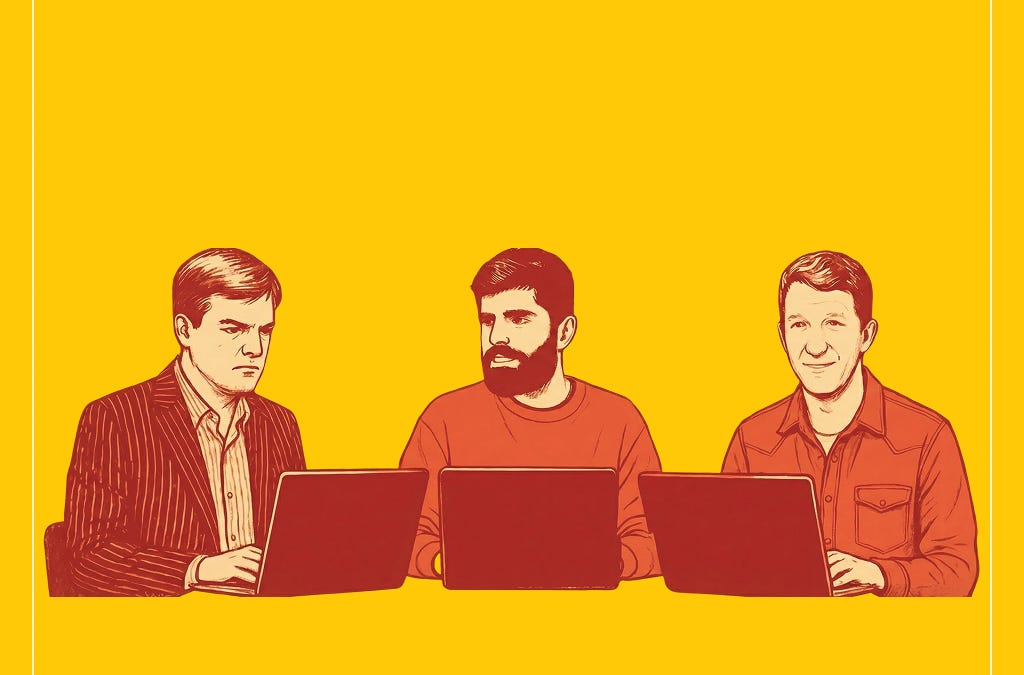
This piece presents a dialogue-style discussion among Michael Burry, Jack Clark, Dwarkesh Patel, and Patrick McKenzie, moderated by McKenzie, on whether AI represents a real breakthrough or a misallocation of capital. It traces the shift from traditional, scratch-built AI agents to large-scale pre-training and data-driven modeling, highlighting the role of Transformers, scaling laws, and the emergence of agents imbued with pre-trained insights. The conversation probes potential economic disruptions, policy implications, and timelines for AI-driven changes, offering varied expert perspectives and historical context to understand how AI could reshape markets and everyday life.
Subtle bias: The format brings in multiple, reasonably credentialed voices, but framing centres Burry’s skepticism about AI capex and profitability; bullish cases are present yet less fully developed than the downside scenarios.
METR’s 2025 RCT found experienced devs using AI coding tools finished tasks about 19–20% slower, while believing they were faster.
Directly matches METR’s own write‑up and secondary coverage summarizing 19% slowdown vs ~20% perceived speedup. Sources: METR study · Ars Technica summary
Today’s SaaS/software‑as‑a‑service revenue is well under $1 trillion annually; estimates cluster in the $250–400B range.
Multiple market reports and Gartner’s SaaS forecast put global SaaS spend far below $1T; claim that SaaS “pie” is < $1T is accurate. Sources: Grand View SaaS outlook · Gartner SaaS forecast
AI infrastructure/data‑center capex is already in the hundreds of billions per year and is forecast into multi‑trillion totals by late 2020s.
Citi and Dell’Oro forecasts, plus hyperscaler capex data, support talk of “trillions” flowing into AI‑related infrastructure. Sources: Citigroup AI capex forecast · Dell’Oro data‑center capex
So far, measurable labour‑market impacts from AI on overall employment are modest; major institutions find no clear drop in labour demand.
OECD and other analyses find AI exposure but “no signs of slowing labour demand yet,” consistent with the article’s caution. Sources: OECD Employment Outlook 2023
Nvidia currently earns the vast majority of its revenue from data‑center/AI chips and dominates the data‑center GPU market.
Recent earnings show ~90%+ of revenue from data‑center and estimates of >90% GPU share; supports claims of Nvidia’s central role. Sources: Nvidia FY26 Q2 results · Earnings coverage
Zero‑sum framing of GDP and “arithmetically constrained pies”
Burry suggests economies have fixed, non‑expanding “pies,” implying AI spending must merely reallocate output. In reality, productivity‑enhancing tech can expand real GDP over time, so the choice is not purely zero‑sum.
Overgeneralising from narrow productivity evidence
Several participants lean heavily on one early, specific METR coding study to question broad AI productivity, while acknowledging data are “conflicting and sparse.” Extrapolating from a small, specialised sample to all AI use risks hasty generalisation.
Assuming competition must erase most producer surplus
The escalator analogy implies rival firms’ AI adoption will always fully pass gains to customers. In practice, sectors with network effects, IP, or scale economies (cloud, chips, platforms) can maintain supra‑normal margins even with widespread adoption.
Big Tech executives
Leaders at Microsoft and Nvidia argue massive AI capex is rational because AI will materially raise productivity and expand addressable markets from ads to labour itself; near‑term ROIC compression is framed as an investment phase. Sources: Dwarkesh–Nadella interview · Nvidia CEO on $3–4T data‑center spend
Mainstream labour economists and policy bodies
OECD and similar institutions see AI as raising both automation and task creation; they expect reallocation and skill shifts rather than sudden mass unemployment, and emphasise education, retraining, and social insurance over protectionism. Sources: OECD Employment Outlook 2023
AI accelerationists / techno‑optimists
Some researchers and investors believe scaling plus recursive self‑improvement will soon produce AGI‑level systems, driving explosive growth that easily repays today’s trillions in capex; from this view, the main risk is under‑investing or over‑regulating. Sources: Epoch on scaling & distributed training · Nvidia CEO on AI augmenting large shares of GDP
AI capex boom vs historical tech bubbles and infrastructure cycles
Analysts compare today’s AI data‑center buildout to railroads and dot‑com: very high capex relative to current revenue, with risk of overbuild and stranded assets but also potential long‑run productivity gains. Sources: Fortune on AI capex & GDP · Network World on $1.1T data‑center capex
Mixed evidence on AI’s productivity impact, especially for coding
Besides METR’s negative result for experienced OSS devs, other studies and vendor reports find gains on simpler or greenfield tasks, suggesting AI’s productivity effect is highly context‑dependent. Sources: METR RCT · InfoWorld summary
Enterprise software and SaaS remain a minority of total IT and GDP
Even with strong growth, enterprise software (~$900B) and SaaS (~$250–400B) are small versus total IT (~$5T) and global GDP, which limits how much AI software alone can directly justify multi‑trillion hardware spend. Sources: Gartner enterprise software market share · Gartner IT spending forecast
Early evidence on AI and jobs: exposure high, displacement slow
Research finds many occupations exposed to AI, especially white‑collar roles, but aggregate employment and labour demand have not yet fallen; adjustment may be gradual and uneven across groups. Sources: OECD Employment Outlook 2023
Competing narratives from industry leaders
While Burry emphasises ROIC compression and bubble risk, Nvidia’s Jensen Huang and Microsoft’s Satya Nadella publicly argue that AI infrastructure is akin to power plants or factories and will unlock trillions in value if productivity gains arrive. Sources: Nvidia blog, “AI is infrastructure” · Nadella interview with Dwarkesh
Does anything look off?

© 2025 Unbubble News. All rights reserved.
Made with care for a more informed world.